
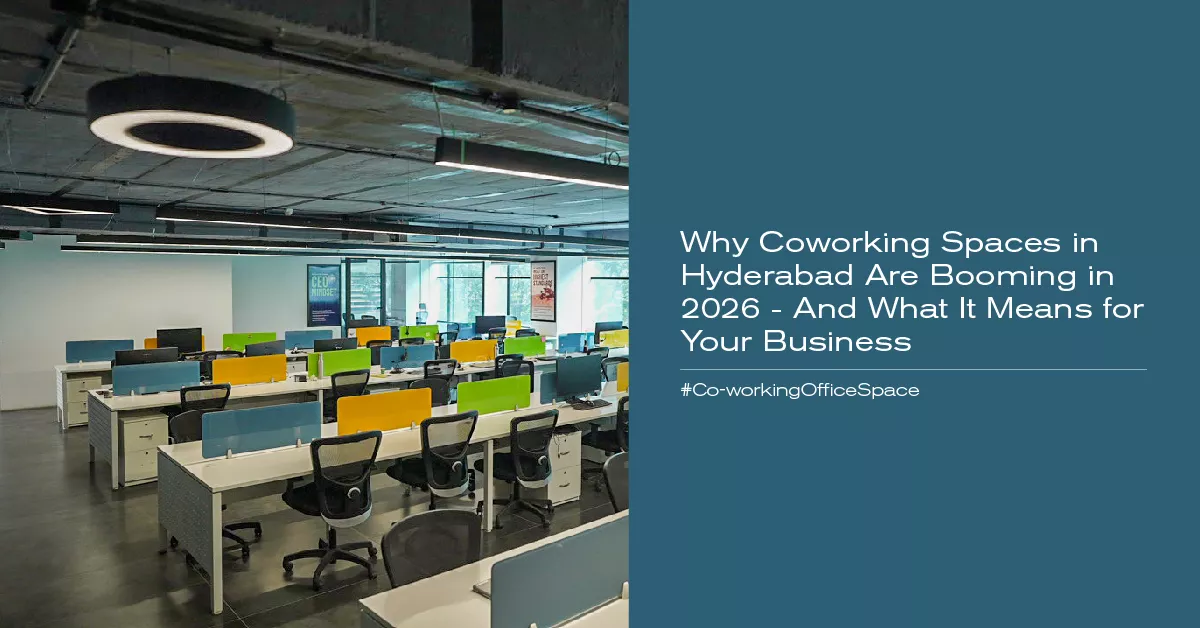
Hyderabad isn’t just keeping pace with India’s coworking boom – it’s leading it. According to Colliers India’s H1 2026 report, coworking operators leased a record 8.6 million sq. ft. of office space across India’s seven largest cities between January and June 2026, a 32% jump from 6.5 million sq. ft. in the same period last year. Bengaluru, Delhi-NCR, and Hyderabad together accounted for nearly two-thirds of that leasing activity, placing coworking space Hyderabad firmly among the country’s top three markets for flexible workspace demand.
For businesses evaluating where to base their next office, this isn’t a trend to watch from the sidelines. It’s a signal that co working space in Hyderabad has matured into a genuine alternative to traditional leasing, not just a startup-stage stopgap.
Why the Surge, and Why Now
Several forces are converging at once. Flexible workspace operators now account for 24% of all office transactions nationally, up from a smaller share just two years ago – driven largely by technology firms, multinational corporations, and Global Capability Centres (GCCs) that increasingly prefer flexible real estate over long-term commitments. Hyderabad’s own office market backs this up: HITEC City’s Grade A rents climbed 9% to ₹72 per sq. ft. per month in Q1 2025 alone, reflecting tight vacancy and sustained enterprise demand across the western business corridor – HITEC City, Madhapur, Gachibowli, and the Financial District – which together host roughly 80% of Hyderabad’s total office stock.
For a business deciding between a traditional lease and a coworking office space, this data matters practically. Rising Grade A rents make the upfront capital cost of a conventional office increasingly hard to justify for teams that haven’t yet locked in a multi-year growth trajectory – which is exactly the gap managed office spaces and flexible workspace formats are built to fill.
What This Means If You’re Choosing a Workspace Right Now
The practical takeaway for founders and facilities leads isn’t just “coworking is growing” – it’s that the format itself has shifted. Shared office spaces in Hyderabad today range far beyond a shared desk: private cabins, dedicated floors, and enterprise-scale managed offices now sit under the same coworking umbrella, largely because GCCs and larger tech occupiers have pulled the entire category upmarket.
This matters when you’re comparing options on Dwaraka Group’s coworking spaces across the city – a five-person team and a two-hundred-person enterprise floor can now realistically operate under the same provider, in the same building, without either format feeling like an afterthought. If your priority is Hyderabad’s tech corridor specifically, coworking spaces for rent in Madhapur, like Dwaraka Central, reflect this same shift toward fully furnished, scalable formats – while businesses closer to the innovation belt often look to coworking spaces in Gachibowli for proximity to IT parks and enterprise campuses. Dwaraka Icon in Kavuri Hills offers a similar model for teams prioritising that corridor instead.
What to Actually Verify Before Signing
Growth statistics are useful context, but they don’t replace due diligence on a specific space. Before committing to any of the best coworking spaces in Hyderabad, confirm:
- Scalability – can you add seats or move to a larger floor without relocating?
- True inclusions – does “furnished” cover internet and meeting rooms, or just desks?
- Support structure – a dedicated relationship manager, or a shared helpdesk queue?
- Rent trajectory – given HITEC City’s 9% rent increase in a single quarter, ask whether your rate is locked for the lease term.
Frequently Asked Questions
Why are coworking spaces in Hyderabad growing so fast in 2026?
Coworking operators leased a record 8.6 million sq. ft. across India’s top cities in H1 2026, a 32% year-on-year increase, with Hyderabad among the top three cities driving that growth alongside Bengaluru and Delhi-NCR, according to Colliers India.
Is coworking only for startups, or do larger companies use it too?
No – flexible workspace demand today is increasingly driven by GCCs, multinational corporations, and technology firms seeking scalable, enterprise-grade formats, not just early-stage startups.
How much do Grade A office rents cost in Hyderabad’s HITEC City?
Grade A rents in HITEC City rose 9% to approximately ₹72 per sq. ft. per month in Q1 2025, reflecting tight vacancy in the corridor.
What’s the difference between a coworking space and a managed office space?
A coworking space typically involves shared common areas across multiple businesses, while a managed office space usually offers a dedicated, private floor or cabin with facility management included – many providers now offer both formats within the same building.
Which parts of Hyderabad have the most coworking and office space supply?
The western corridor – HITEC City, Madhapur, Gachibowli, and the Financial District – hosts roughly 80% of Hyderabad’s total office stock.
Should I choose a flexible workspace over a traditional lease in 2026?
With flexible operators now accounting for 24% of all office transactions nationally and Grade A rents rising in key Hyderabad corridors, a flexible format increasingly offers lower upfront risk than a long-term traditional lease, particularly for teams still scaling.
Conclusion
Hyderabad’s coworking market isn’t growing quietly – it’s now one of the three cities driving nearly two-thirds of India’s flexible workspace expansion, backed by real leasing data, not projections alone. For businesses weighing a traditional lease against a more flexible format, the numbers suggest the flexible route is no longer the cautious choice – it’s increasingly the default one for a fast-moving city like Hyderabad. Explore Dwaraka Group’s full range of coworking spaces to see how this shift translates into real, available workspace across the city’s leading business corridors.